
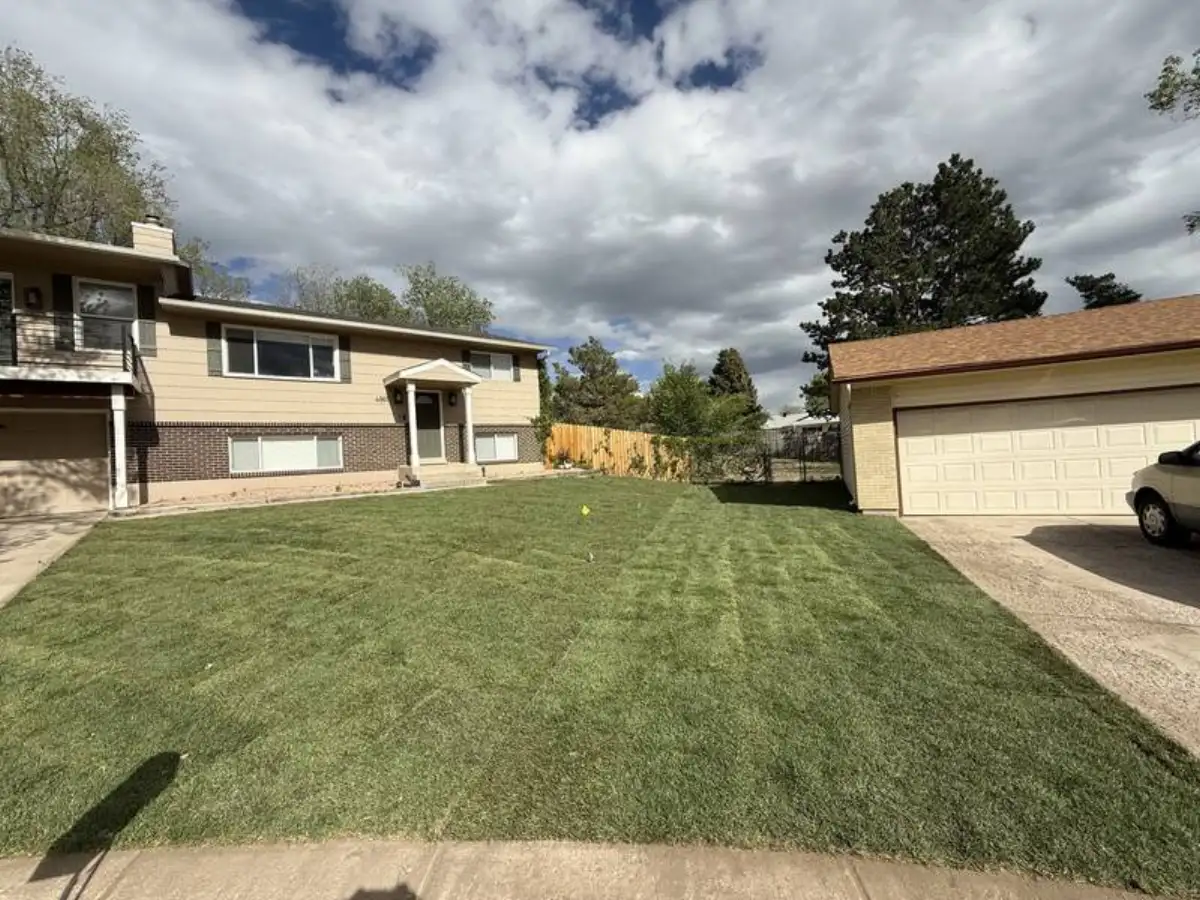
The best time to install sod in Colorado Springs is mid-May through mid-June. The last average frost date has passed, soil temperatures are warm enough for root establishment, and you get six to eight weeks of consistent growing conditions before the hottest stretch of summer. Miss this window and you are fighting evaporation rates, afternoon thunderstorms, and heat stress that make establishment significantly harder.
Colorado Springs sits at 6,035 feet with alkaline clay soil, intense UV radiation, and only 15 to 17 inches of annual precipitation. These conditions make sod installation different from what you will read in most national lawn care guides. This article covers what actually works here, based on years of installing sod across the Pikes Peak region from Monument to Fountain.
Choosing the Right Grass Type for Altitude
Not every grass survives at 6,000 feet in Zone 5b. The combination of cold winters (down to minus 20 degrees some years), intense summer UV, alkaline soil (pH 7.2 to 8.0), and low annual rainfall eliminates most warm-season varieties and several cool-season options. Here are the three grass types that consistently perform well in Colorado Springs.
Kentucky Bluegrass
Kentucky bluegrass is the most popular sod choice in Colorado Springs and for good reason. It produces a dense, dark green lawn with excellent cold tolerance and strong recovery from damage. The self-spreading rhizome system fills in thin spots naturally, which is valuable in a climate where winter stress and chinook wind desiccation thin lawns every year.
The tradeoff is water. Kentucky bluegrass needs 1 to 1.5 inches of water per week through the growing season, and in Colorado Springs, almost all of that comes from irrigation. At altitude, evaporation rates are roughly 30 percent higher than at sea level, so you may actually need closer to 1.5 to 2 inches of applied water per week to deliver 1.5 inches to the root zone.
Tall Fescue
Tall fescue is the best option for homeowners who want a green lawn with less water than Kentucky bluegrass. It has deeper roots (up to 4 feet compared to bluegrass at 2 feet), which helps it access soil moisture during dry spells. Tall fescue also handles shade better than bluegrass, making it the better choice for north-facing yards or areas under mature trees.
The disadvantage is that tall fescue is a bunch-type grass, meaning it does not spread by rhizomes. Damage to a fescue lawn requires overseeding to repair, while bluegrass can fill itself in. Many Colorado Springs homeowners use a bluegrass and fescue blend that combines the self-repair ability of bluegrass with the drought tolerance and shade performance of fescue.
Buffalo Grass
For the lowest water option, buffalo grass is a native prairie species that thrives on as little as 0.5 inches of water per week once established. It is the best companion to a xeriscape design, providing a soft green lawn in the areas where you want turf without the irrigation demand of traditional grass. Buffalo grass goes dormant and turns brown during extended dry periods but greens up quickly with the next rain or watering.
Buffalo grass grows slowly and has a lighter green color than bluegrass. It also takes longer to establish, so patience is required during the first season. It performs best in full sun and open areas; it will not compete well in shade.
Soil Preparation: The Step Most People Skip
Soil preparation is the single most important factor in sod success in Colorado Springs, and it is also the step most DIY installations get wrong. Our clay soil is dense, alkaline, and poorly draining. Laying sod directly on top of existing clay without amendment is a recipe for shallow roots, poor drainage, and a lawn that struggles through its first summer.
Remove Existing Vegetation
If you have existing grass, weeds, or vegetation, it must be completely removed before new sod goes down. A sod cutter or skid steer with a grading attachment strips the old lawn cleanly. Do not try to lay new sod over dead grass or freshly sprayed lawn. The decomposing material creates a barrier between the new sod roots and the soil below, preventing proper root establishment.
Grade and Level the Surface
The final grade should slope away from your home at a minimum of 2 percent (roughly 1 inch of drop per 4 feet). This prevents water from pooling against your house during Colorado Springs' intense summer thunderstorms. Any low spots that hold water need to be filled and compacted. High spots should be cut down. The finished grade should be approximately 1 inch below the level of adjacent walkways, patios, and driveways so the sod surface ends up flush after installation.
Amend the Soil
Colorado Springs clay soil needs organic matter. Spread 2 to 3 cubic yards of quality compost per 1,000 square feet over the graded surface, then till it in to a depth of 4 to 6 inches. This accomplishes three things: it breaks up the clay structure to improve drainage, it lowers the pH slightly (compost is mildly acidic, which helps in our alkaline conditions), and it increases the soil's ability to hold nutrients and moisture at the root zone. A soil test through the El Paso County Extension office before you amend gives you specific recommendations for your property.
Final Rake and Roll
After tilling in amendments, rake the surface smooth and roll it lightly with a half-filled lawn roller. This settles the soil enough to prevent the sod from sinking unevenly after watering, while still leaving the surface loose enough for roots to penetrate. The finished surface should be firm but not compacted.
Installation Day: Timing and Technique
Schedule sod delivery for early morning, ideally on a day when temperatures will stay below 85 degrees. Fresh sod sitting on a pallet in Colorado's direct sun heats up rapidly, and the interior of the pallet can reach temperatures that kill the grass within hours. If you cannot install the entire order the same day it arrives, unroll any remaining pallets in a shaded area and keep them moist.
Laying Pattern
Start along the longest straight edge in your yard, typically a driveway, sidewalk, or fence line. Lay each row tightly against the previous one with staggered seams, similar to a brick pattern. Push the edges together firmly; do not overlap them and do not leave gaps. On slopes, lay sod perpendicular to the grade (across the hill, not up and down it) and secure with biodegradable sod staples every 2 feet to prevent sliding during watering.
Edges and Curves
Use a sharp utility knife to cut sod pieces to fit around curves, sprinkler heads, landscape lighting fixtures, and bed edges. Do not use small scraps at the edges of the lawn; place full or half pieces at exposed edges where they will receive the most sun and wind exposure. Save smaller pieces for interior areas where they are protected by surrounding sod.
Roll and Water Immediately
After all sod is laid, roll the entire lawn with a lawn roller to press the sod into firm contact with the prepared soil. Then begin watering immediately. The goal is to soak through the sod and wet the top 3 to 4 inches of underlying soil. This first watering is critical. Any sod that dries out between installation and initial watering will struggle to root.
Watering Schedule for Colorado Springs Altitude
Watering new sod at 6,000 feet is different from watering at sea level. Our lower air pressure, higher UV, lower humidity, and frequent afternoon winds increase evaporation dramatically. Here is a watering schedule calibrated for Colorado Springs conditions.
Weeks 1 and 2: Keep It Wet
Water 2 to 3 times daily for 10 to 15 minutes per session. The soil under the sod should stay consistently moist but not puddled. Early morning (6 AM), midday (11 AM), and mid-afternoon (3 PM) sessions work well. The midday watering is especially important at altitude because afternoon evaporation can dry the sod surface within hours on a sunny, windy day.
Weeks 3 and 4: Start the Transition
Reduce to once daily, increasing the duration to 20 to 30 minutes. This encourages roots to grow deeper by allowing the surface to dry slightly between waterings. Check root progress by gently tugging a corner of sod. If it resists lifting, roots are anchoring. If it lifts easily, maintain the more frequent schedule for another week.
Weeks 5 and 6: Deep Watering
Transition to every other day, watering 30 to 45 minutes per session. The goal is to push water to a 6-inch depth, training roots to follow the moisture down into the amended soil. By week six, your new lawn should be on a normal Colorado Springs watering schedule: 1 to 1.5 inches per week divided into 2 to 3 sessions.
Colorado Springs Watering Restrictions
Colorado Springs Utilities enforces watering schedules from May through October. Odd-numbered addresses water on Wednesday, Friday, and Sunday. Even-numbered addresses water on Tuesday, Thursday, and Saturday. New sod installations may qualify for a temporary watering exemption during the establishment period. Contact Colorado Springs Utilities before installation to request the exemption and avoid citation.
Common Mistakes to Avoid
- Skipping soil amendment: Colorado Springs clay without compost amendment will not support healthy sod long-term. The roots stay shallow, the lawn thins every winter, and you spend more on water and repairs than the amendment would have cost.
- Installing in July or August: Afternoon temperatures above 90 degrees and intense UV stress new sod severely. Establishment rates drop and water consumption doubles. May, June, and September are far better windows.
- Underwatering at altitude: National lawn care guides assume sea-level evaporation rates. At 6,000 feet, you need roughly 30 percent more applied water to deliver the same amount to the root zone.
- Mowing too soon or too short: Wait until the sod has fully rooted (typically 3 to 4 weeks) before the first mow. Set your mower to 3 to 3.5 inches. Never cut more than one-third of the blade height in a single mowing.
- Fertilizing immediately: New sod has enough stored nutrition for the first 4 to 6 weeks. Applying fertilizer too early can burn shallow roots. Wait until after the first mow to apply a starter fertilizer with balanced nitrogen and phosphorus.
How Much Does Sod Installation Cost in Colorado Springs?
Professional sod installation in Colorado Springs ranges from $1.50 to $3.00 per square foot, depending on soil condition, accessibility, grade work required, and grass variety. Here are typical project ranges:
- Small yard (500-1,000 sq ft): $750 to $3,000
- Average yard (1,500-3,000 sq ft): $2,250 to $9,000
- Large yard (4,000-6,000 sq ft): $6,000 to $18,000
These prices include soil preparation, compost amendment, sod material, installation labor, and initial watering setup. Properties with significant grade issues, poor drainage, or rocky subsoil may cost more due to additional excavation and grading work.
Frequently Asked Questions
When is the best time to install sod in Colorado Springs?
Mid-May through mid-June is the ideal window. The last frost date has passed (around May 10), soil temperatures support root growth, and you have consistent growing conditions before summer heat peaks. September through early October is the second-best window for cool-season sod.
What type of sod grows best in Colorado Springs?
Kentucky bluegrass is the most popular choice for Colorado Springs lawns. It handles cold winters, high-altitude UV, and alkaline clay soil when properly maintained. Tall fescue works well for shadier areas or lower water use. Buffalo grass suits xeriscaping with minimal irrigation needs.
How much does sod installation cost in Colorado Springs?
Professional sod installation typically costs $1.50 to $3.00 per square foot, including soil preparation, sod, and installation. A 1,000 square foot lawn runs $1,500 to $3,000 installed. Costs vary based on soil condition, accessibility, and the grass variety selected.
How often should I water new sod in Colorado Springs?
Water 2 to 3 times daily for the first two weeks, keeping the soil consistently moist. At 6,000 feet, evaporation rates are 30 percent higher than sea level, so you need more frequent watering than national guides suggest. Reduce to once daily by week three, then transition to deep watering of 1 to 1.5 inches per week by week six.
Get Professional Sod Installation
A properly installed lawn transforms a property and adds years of usable outdoor space. CN Landscaping handles every step of the sod installation process across Colorado Springs, Monument, Fountain, Falcon, Black Forest, Larkspur, and Perry Park. We manage soil testing, amendment, grading, installation, and post-install care guidance so your new lawn establishes correctly the first time.
Call (719) 460-5685 or request a free estimate online to get your sod installation scheduled during the ideal spring window.